Why your YNAB balance is lowest the day before payday
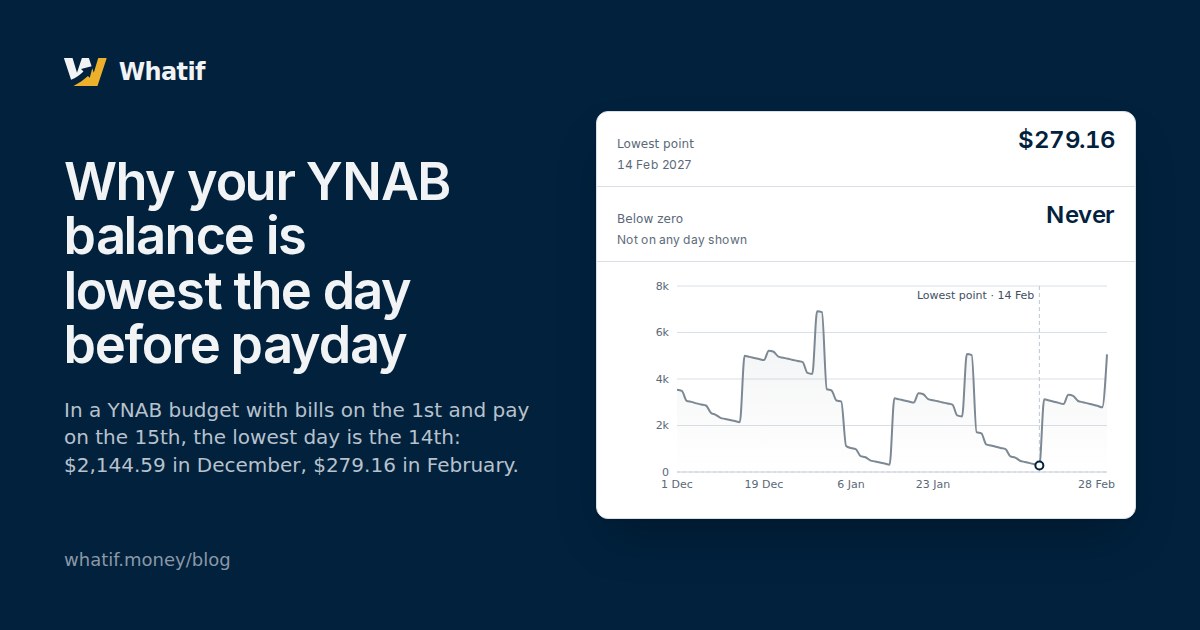
In a YNAB budget with bills on the 1st and pay on the 15th, the lowest day is the 14th: $2,144.59 in December, $279.16 in February.
By Fareed · · Updated
If your mortgage, rent or childcare leaves on the 1st and your first paycheck arrives on the 15th, the lowest your checking account gets each month is the 14th. Every bill due before payday has left by then, the everyday spending has gone on every day, and nothing has come in. A month that breaks even on paper can still come close to zero on that one day.
YNAB tells you what each category has to spend today. It doesn’t walk your accounts forward a day at a time, so it can’t tell you how low the 14th will be, or which month’s 14th is the lowest. That is what a forecast is for, and how Whatif forecasts a YNAB budget explains how one is worked out.
Here is that day in one budget: the Austin household, Whatif’s sample budget, whose big bills land on the 1st to the 3rd and whose pay lands on the 15th and the 30th. Over the next three months, the 14th is the lowest point each time: $2,144.59 in December, $316.59 in January and $279.16 in February, which is the lowest point of the whole twelve-month forecast. The figures below are the engine’s, worked out a day at a time from 5 November 2026.
- Lowest point
- $279.16
- 14 Feb 2027
- Below zero
- Never
- Not on any day shown
What leaves before the 15th
December starts from $6,840.68, the balance at the close of 30 November. By the close of the 14th it is $2,144.59. In those fourteen days, $4,696.09 leaves and nothing arrives.
- Lowest point
- $2,144.59
- 14 Dec 2026
- Below zero
- Never
- Not on any day shown
| Day | Item | Amount |
|---|---|---|
| 1 December | Childcare | −$980.00 |
| 1 December | Mortgage | −$1,680.00 |
| 1 December | Visa | −$600.00 |
| 3 December | Property tax | −$380.00 |
| 5 December | Streaming | −$18.00 |
| 8 December | Student loan | −$260.00 |
| 9 December | Gym | −$45.00 |
| 10 December | Internet & phone | −$85.00 |
| 1–14 December | Category spending | −$648.09 |
The dated items come to $4,048.00, and $3,640.00 of that is gone by the close of the 3rd. The last line is spending with no date of its own — Groceries, Gas & transit, Dining out and the rest — which the forecast spreads across the days of the month, so each of the fourteen days carries its share.
What arrives after it
From the 15th to the 31st the month runs the other way. $2,900.00 lands on the 15th, $450.00 of contract invoices on the 20th and $2,900.00 again on the 30th. Against that come three dated items — electric, the car loan and a Roth IRA deposit, $735.00 together — and the second half’s share of the category spending, $786.91.
December closes at $6,872.68. Over the whole month the household is $32.00 better off. A month’s total says that, and nothing about the $4,696.09 that came and went in the middle.
Which month’s 14th is the lowest
| Month | Starts from | Lowest point | On | Closes at |
|---|---|---|---|---|
| December | $6,840.68 | $2,144.59 | 14 December | $6,872.68 |
| January | $6,872.68 | $316.59 | 14 January | $5,026.68 |
| February | $5,026.68 | $279.16 | 14 February | $5,058.68 |
January has one more bill in its first two weeks: the auto insurance, $1,860.00 once a year, on 5 January. Its first fourteen days take $6,556.09, and its lowest point is $1,828.00 lower than December’s.
February has no yearly bill, and its lowest point is lower again. Two things make it so. January closes $1,846.00 below where it started, because the insurance is paid out of it and nothing extra arrives to cover it, so February starts from $5,026.68 rather than $6,872.68. And February has 28 days: the same month of category spending is shared across fewer of them, so its first fourteen days carry $717.52 of it, against December’s $648.09.
So the lowest day of the year is not the month of the big yearly bill. It is the month after, which starts from what that bill left behind.
Why it is always the day before payday
The forecast reaches thirteen calendar months, from this November to next, and in all thirteen the lowest day is the 14th. The insurance in January changes how far the 14th falls, and not which day it is.
The day is set by the calendar, not by the amounts. Every bill due from the 1st to the 14th leaves before any pay arrives, and the category spending goes on leaving every day, so the day before the first payday is the day the month has paid the most and been paid nothing. That is why a lowest point is a day rather than a month: the month’s total for December is $32.00, and its lowest day is $4,696.09 below where it started.
Finding the day in your own budget
Whatif reads your YNAB budget — balances, scheduled transactions and targets — and forecasts it a day at a time, and shows the lowest point and the day it falls on. The Austin household is the sample budget: open it to see each of these months a day at a time, with no account needed. To see your own 14th, or whichever day it is for you, connect your YNAB budget; the fourteen-day trial needs no card.
How this was worked out
The household is the one the sample budget opens, forecast from 5 November 2026 to 30 November 2027 with its schedules and targets as they stand on that day. A month starts from the balance at the close of the day before it, because the balance on the 1st has already paid the 1st’s bills. Each month’s lowest point is the lowest balance at the close of any of its days, and the first of them when two are equal.