How low does my account get before a payday on the 25th?
Paid on the 25th, the low is the 24th unless more pay lands mid-month. In one sample budget the 11th and the 24th close within 654,46 kr of each other.
By Fareed ·
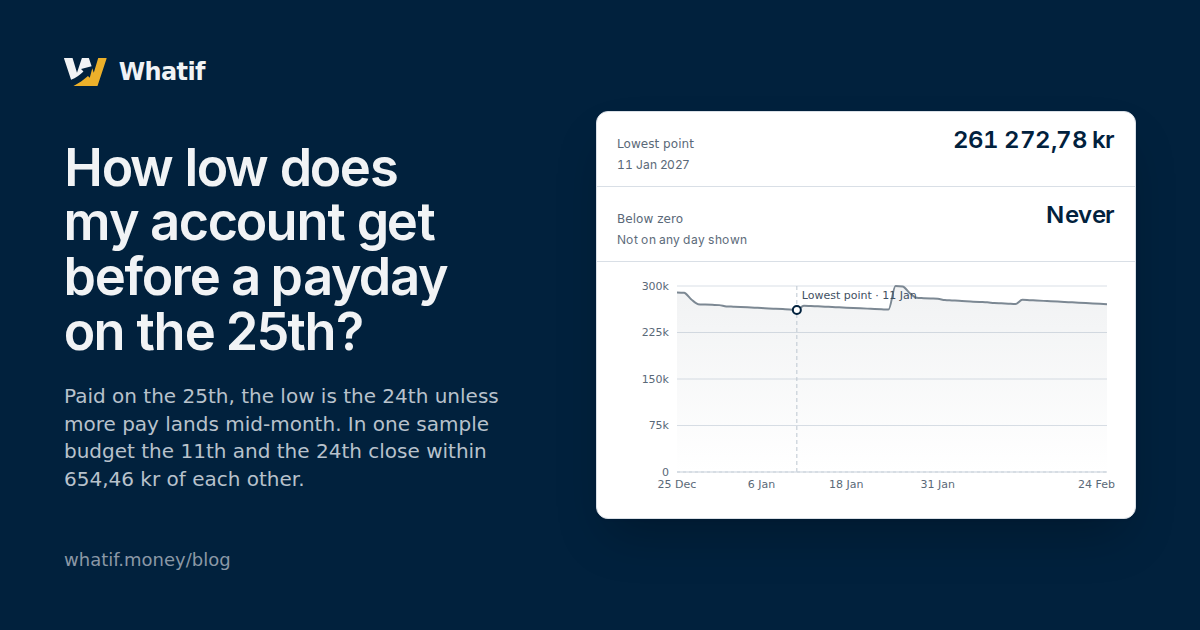
Paid once a month on the 25th, the stretch your cash has to last runs from one 25th to the 24th of the next month, across the 1st. The bills that leave in the days after payday — rent, the mortgage, loan payments — take their share first, and everything after that runs on what is left, so the lowest day is the 24th, the day before the next payday. If something else arrives in the middle of the month, the stretch has two low days instead of one: the day before that money lands, and the day before payday. Which of the two goes lower depends on whether the money in the middle covers the days after it.
YNAB budgets the money you have today, and a paycheck on the 25th is money you give jobs to when it arrives. It doesn’t walk your accounts forward a day at a time, so it can’t show how low the 24th will be, or whether a day earlier in the month goes lower. A forecast does, and how Whatif forecasts a YNAB budget explains how one is worked out.
Which day is lowest between two paydays
Here is one budget showing it: the Stockholm household, one of Whatif’s sample budgets, forecast from 10 November 2026 to 30 November 2027. Its salary, 38 500,00 kr, lands on the 25th. A second, smaller inflow, 7 500,00 kr of consulting invoices, lands on the 12th. Its cash is three accounts together: checking, a savings buffer and a cash wallet.
From the payday on 25 December to the day before the next, the lowest point is 261 272,78 kr, on 11 January, and the balance on 24 January is 261 927,24 kr. From 25 January to 24 February, the lowest point is the day before payday itself: 270 761,18 kr, on 24 February, with 11 February at 270 840,17 kr.
- Lowest point
- 261 272,78 kr
- 11 Jan 2027
- Below zero
- Never
- Not on any day shown
What leaves after the 25th
In the three days after the payday on 25 January, four payments leave: the mortgage, 8 900,00 kr, and the student loan, 1 100,00 kr, on the 27th; the car loan, 3 150,00 kr, and the housing fee, 4 250,00 kr, on the 28th. Together they come to 17 400,00 kr. From the close of 25 January to the close of the 28th, 18 979,73 kr leaves: those four payments and three days of category spending.
After that come the Visa payment on the 1st, 1 500,00 kr, the streaming and gym charges, and the category spending — Groceries, Electricity, Eating out and the rest — which the forecast spreads across the days of the month. From the close of 25 January to the close of 11 February, 29 060,50 kr leaves.
Why the 11th and the 24th come so close
The 7 500,00 kr on the 12th lifts the line, and the thirteen days from the 12th to the 24th take it back down. In a 31-day month, those thirteen days carry 6 845,54 kr of category spending, less than the invoices, so the 24th closes above the 11th: in January, 654,46 kr above it. In February, the same month of spending is shared across 28 days, and the same thirteen days carry 7 578,98 kr, more than the invoices. So February’s 24th goes lower than its 11th, by 78,98 kr. In a 30-day month like April they carry 7 073,73 kr.
A gym or streaming charge that falls between the 12th and the 24th narrows the gap the same way. In September both fall in it, and the 24th is the lowest day of that pay period.
Every pay period in the forecast
| Payday | At the close of payday | Lowest point | On | The day before the next payday |
|---|---|---|---|---|
| 25 November 2026 | 274 019,19 kr | 251 533,78 kr | 11 December | 251 739,24 kr |
| 25 December 2026 | 289 712,66 kr | 261 272,78 kr | 11 January | 261 927,24 kr |
| 25 January 2027 | 299 900,66 kr | 270 761,18 kr | 24 February | 270 761,18 kr |
| 25 February 2027 | 308 678,19 kr | 276 748,78 kr | 11 March | 277 403,24 kr |
| 25 March 2027 | 315 376,66 kr | 286 743,72 kr | 11 April | 287 169,99 kr |
| 25 April 2027 | 325 125,86 kr | 289 834,78 kr | 11 May | 290 489,24 kr |
| 25 May 2027 | 328 462,66 kr | 299 829,72 kr | 11 June | 300 116,99 kr |
| 25 June 2027 | 338 072,86 kr | 310 210,78 kr | 11 July | 310 726,24 kr |
| 25 July 2027 | 348 699,66 kr | 320 398,78 kr | 11 August | 320 465,24 kr |
| 25 August 2027 | 358 438,66 kr | 330 231,99 kr | 24 September | 330 231,99 kr |
| 25 September 2027 | 368 187,86 kr | 340 807,85 kr | 11 October | 340 874,31 kr |
| 25 October 2027 | 378 847,73 kr | 352 141,06 kr | 24 November | 352 141,06 kr |
Of the twelve pay periods, the lowest day is the 11th in nine and the 24th in three. In none of them are the two more than 654,46 kr apart. Each period’s lowest point is higher than the one before, because the household is paid more than it spends, and the line climbs across the year.
- Lowest point
- 233 938,40 kr
- 11 Nov 2026
- Below zero
- Never
- Not on any day shown
In a budget paid twice a month, the low comes before each of the two paydays instead; why your YNAB balance is lowest the day before payday works through one with bills on the 1st and pay on the 15th.
Finding it in your own budget
Whatif reads your YNAB budget — balances, scheduled transactions and targets — and forecasts it a day at a time, and shows the lowest point and the day it falls on. The Stockholm household is one of the four households in the sample budget, a menu away from the one it opens, with no account needed, and nothing you change here is saved. To see how low your own account gets before your own payday, connect your YNAB budget; the fourteen-day trial needs no card.
How this was worked out
The household is the Stockholm one from the sample budget, forecast from 10 November 2026 to 30 November 2027 with its schedules and targets as they stand on that day. A pay period runs from a payday to the day before the next one, so the days before the first payday and after the last are left out. Its lowest point is the lowest balance at the close of any of its days, the first of them when two are equal.