Why is my balance lowest after a yearly bill I saved for?
Money set aside for a yearly bill stays in checking until it leaves. In one sample budget, a $1,860 renewal moves the year's low from $2,087.32 to $283.48.
By Fareed ·
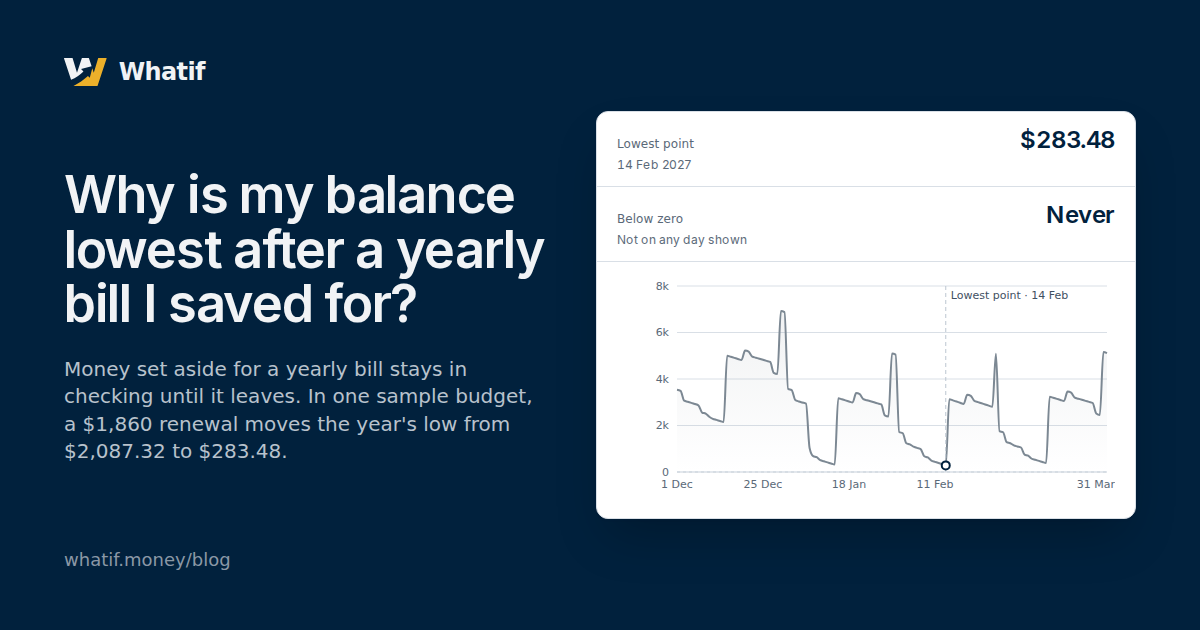
If you set money aside every month for a yearly bill, that money never leaves your checking account until the bill does. Assigning it to a category in YNAB changes what the category has available; it does not move cash. So on the day the renewal is paid, the whole of it leaves at once, and every day after that starts lower by the full amount. The year’s lowest point often lands after the bill, at the next day the account was already going to be thin — the day before a payday, in the month after the renewal.
YNAB budgets the money you have today, so a yearly bill you have funded looks taken care of, and in the budget it is. YNAB doesn’t walk your accounts forward a day at a time, so it can’t show the day the renewal leaves checking, or how low the balance gets in the weeks that follow. A forecast does, and how Whatif forecasts a YNAB budget explains how one is worked out.
How far one renewal moves the lowest point
Here is one budget showing it: the Austin household, Whatif’s sample budget. Its auto insurance is $1,860.00 once a year, and the next renewal is 7 January. The forecast starts on 7 November 2026 and runs to 30 November 2027.
With the renewal, the lowest point of the forecast is $283.48, on 14 February. Take the renewal out and change nothing else, and the lowest point is $2,087.32, on 14 November. The one bill lowers the year’s lowest point by $1,803.84 and moves it three months later.
- Lowest point
- $283.48
- 14 Feb 2027
- Below zero
- Never
- Not on any day shown
The lowest point moves by less than the bill because, without the renewal, it is a different day. Without it, the forecast’s lowest day is this month’s 14th, before the renewal would have been paid. With it, every day from 7 January on is $1,860.00 lower, and the lowest of those days, 14 February, is lower than 14 November.
Why the low comes the month after
The household’s mortgage, childcare and property tax leave on the 1st to the 3rd, and its pay arrives on the 15th and the 30th, so each month’s lowest day is the 14th. Why your YNAB balance is lowest the day before payday works through those months. The renewal does not change which day that is. It changes how far each 14th falls.
| Month | Lowest point, with the renewal | Without it | On |
|---|---|---|---|
| December | $2,148.91 | $2,148.91 | 14 December |
| January | $320.91 | $2,180.91 | 14 January |
| February | $283.48 | $2,143.48 | 14 February |
| March | $384.91 | $2,244.91 | 14 March |
December is the same either way: the renewal has not been paid. From January, each month’s 14th is $1,860.00 lower with it.
January holds the renewal, and its 14th is a week after it. February has no yearly bill, and its 14th is lower again, by $37.43. February has 28 days, so the same month of category spending is shared across fewer of them, and more of it has left by the 14th. That is as true without the renewal as with it: without it, February’s 14th is also $37.43 below January’s. What the renewal adds is that February starts from what the renewal left behind.
How long the renewal stays in the line
Nothing in the forecast pays the $1,860.00 back. The household’s pay and bills are the same with or without it, so the gap opened on 7 January stays open for the rest of the forecast. The forecast closes on 30 November 2027 at $11,620.11 with the renewal and $13,480.11 without it, $1,860.00 apart. The next renewal, in January 2028, is past the end of this forecast.
- Lowest point
- $283.48
- 14 Feb 2027
- Below zero
- Never
- Not on any day shown
Across the year, the line comes closest to zero in February and climbs after it. It does not go below zero with the renewal or without it.
Finding it in your own budget
Whatif reads your YNAB budget — balances, scheduled transactions and targets — and forecasts it a day at a time. A yearly bill scheduled in YNAB lands on its own date in the forecast, at its full amount, whatever its category holds. The forecast shows the lowest point and its day, and each month opens a day at a time, so the day a renewal leaves and the low after it are both on the line. The Austin household is the sample budget: open it with no account needed. To see where your own yearly bills land, connect your YNAB budget; the fourteen-day trial needs no card.
How this was worked out
The household is the one the sample budget opens, forecast from 7 November 2026 to 30 November 2027 with its schedules and targets as they stand on that day. The forecast without the renewal is the same budget with the auto insurance’s scheduled transaction taken out and nothing else changed. A month starts from the balance at the close of the day before it, and its lowest point is the lowest balance at the close of any of its days, the first of them when two are equal.