How far will one big expense set me back?
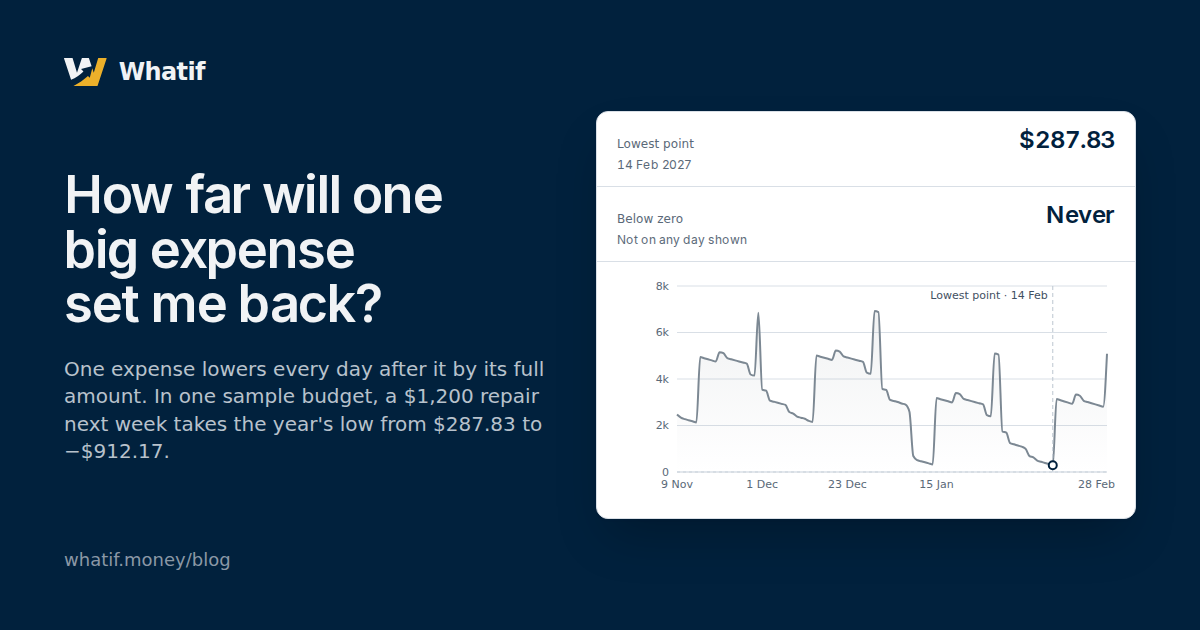
One expense lowers every day after it by its full amount. In one sample budget, a $1,200 repair next week takes the year's low from $287.83 to −$912.17.
By Fareed ·
An expense you pay once lowers your checking balance by its full amount on the day it leaves, and every day after that starts from the lower figure. Nothing in your scheduled pay and bills pays it back, so the gap stays open for as long as the forecast runs. If the year’s lowest day comes after the expense, the lowest point falls by the whole amount. A low that came before it does not move at all. So how far one expense sets you back is decided less by the month you pay it in than by the lowest day still ahead of it.
YNAB budgets the money you have today, and a repair is one more thing that money is given a job for. YNAB doesn’t walk your accounts forward a day at a time, so it can’t show which later day the repair makes the lowest, or how far below it the balance goes. A forecast does, and how Whatif forecasts a YNAB budget explains how one is worked out.
How far one repair moves the lowest point
Here is one budget showing it: the Austin household, Whatif’s sample budget, forecast from 9 November 2026 to 30 November 2027. As it stands, its lowest point is $287.83, on 14 February. Add a $1,200.00 car repair on 16 November, a week from the forecast’s first day, and change nothing else: the lowest point is −$912.17, on the same day. The repair lowers the year’s lowest point by $1,200.00, the whole of it.
- Lowest point
- $287.83
- 14 Feb 2027
- Below zero
- Never
- Not on any day shown
The chart is the budget as it stands. With the repair, the same line runs $1,200.00 lower from 16 November on. The lowest point moves by the full amount because its day comes after the repair. November’s own lowest day, the 14th, comes before it, and it is $2,133.04 with the repair or without it.
Which months go below zero
The household’s mortgage, childcare and property tax leave on the 1st to the 3rd, and its pay arrives on the 15th and the 30th, so each month’s lowest day is the 14th. Why your YNAB balance is lowest the day before payday works through those months. The repair does not change which day that is. It changes how far each 14th falls.
| Month | Lowest point, as it stands | With the repair | On |
|---|---|---|---|
| November | $2,133.04 | $2,133.04 | 14 November |
| December | $2,153.26 | $953.26 | 14 December |
| January | $325.26 | −$874.74 | 14 January |
| February | $287.83 | −$912.17 | 14 February |
| March | $389.26 | −$810.74 | 14 March |
| April | $417.55 | −$782.45 | 14 April |
| May | $891.15 | −$308.85 | 14 May |
| June | $1,321.55 | $121.55 | 14 June |
With the repair, the line first crosses zero on 9 January, at −$513.28. That is the day the household’s yearly auto insurance renews, which why the balance is lowest after a yearly bill follows through the months after it. From then on the line is below zero on 42 days, each of them in the days before a 15th’s paycheck, in every month from January to May. The last is 14 May. After it, the line stays above zero for the rest of the forecast.
How long the repair stays in the line
Nothing in the forecast pays the $1,200.00 back. The household’s pay and bills are the same with or without it, so every day from 16 November to the end of the forecast is $1,200.00 lower. The forecast closes on 30 November 2027 at $11,631.58 as it stands and $10,431.58 with the repair, $1,200.00 apart.
- Lowest point
- $287.83
- 14 Feb 2027
- Below zero
- Never
- Not on any day shown
The line comes back above zero because it climbs past the repair, not because anything repays it. The auto loan is paid off on 28 March 2027 and the Visa card on 1 July 2027, and their payments stay in checking after that. From February on, each month’s lowest point is higher than the one before, with the repair or without it.
The most next week can take
A payment on one day lowers every later day by its amount and nothing else. So the most a single expense on 16 November can be before the line goes below zero later is the lowest balance from that day to the end of the forecast: $287.83, the balance on 14 February. That figure is set by a day three months after the payment, which is why a repair paid in November is measured against February.
Finding it in your own budget
Whatif reads your YNAB budget — balances, scheduled transactions and targets — and forecasts it a day at a time. On What if, a one-off is one of the changes a scenario makes: give it a day and an amount, and it is drawn as a second line against the forecast before anything is saved. A spending added on one day says what it does to the whole forecast — the lowest point, or the day cash goes below zero — and the most that day can take before cash goes below zero later. None of it changes your YNAB budget. The Austin household is the sample budget: open it with no account needed, and nothing you change here is saved. To see what one expense does to your own forecast, connect your YNAB budget; the fourteen-day trial needs no card.
How this was worked out
The household is the one the sample budget opens, forecast from 9 November 2026 to 30 November 2027 with its schedules and targets as they stand on that day. The repair is a single one-off of $1,200.00 on 16 November, folded over that forecast the way What if folds one, with nothing else changed. A month’s lowest point is the lowest balance at the close of any of its days, the first of them when two are equal, and a day below zero is one that closes below zero.